
Can Your Business Reclaim VAT On Expenses?
Find out what you can claim VAT back on, which costs HMRC blocks and how to reclaim VAT on expenses correctly through your VAT return.

Once your business is VAT registered, you charge VAT on your sales and pass it on to HMRC. The good news is that it works both ways. In most cases, you can also reclaim the VAT you pay on the things you buy to run your business, which can make a real difference to your cash flow.
But not every expense qualifies. Some costs are blocked completely, others can only be claimed in part, and a missing invoice can cost you money you were entitled to.
This guide explains who can reclaim VAT, what you can claim VAT back on, the expenses HMRC won’t let you claim and how to make sure you’re claiming everything you should.
Who Can Reclaim VAT On Expenses?
Only VAT-registered businesses can reclaim VAT on expenses. This applies to sole traders, partnerships and limited companies alike. If your business isn’t registered for VAT, the VAT you pay on purchases is simply part of the cost.
To reclaim VAT on a purchase, it must:
- Be for your business. The cost must be used to make taxable sales, rather than for personal or non-business use
- Have been charged VAT. Many items are zero-rated or exempt, so there is no VAT to claim back
- Be supported by a valid VAT invoice. Without the right evidence, HMRC can refuse your claim
How Reclaiming VAT Works
The VAT you pay on purchases is called input VAT. The VAT you charge your customers is called output VAT. On each VAT return, you deduct your input VAT from your output VAT and pay HMRC the difference. If your input VAT is higher, HMRC pays you a refund.
A Worked Example
Imagine a joinery business with £30,000 of sales in a quarter (before VAT) and £8,000 of qualifying costs, such as timber, tools and van repairs (also before VAT).
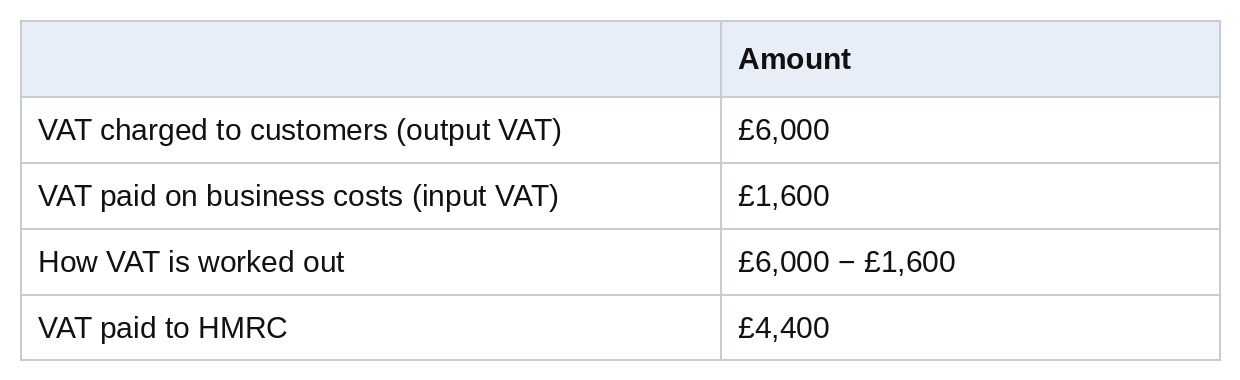
By claiming VAT on expenses correctly, the business keeps £1,600 that it would otherwise have handed to HMRC.
What Can You Claim VAT Back On?
As a general rule, you can reclaim the VAT on goods and services you buy for use in your business. Common examples include:
- Stock and materials you buy to sell on or use in your work
- Equipment and tools, such as computers, machinery and office furniture
- Business premises costs, such as rent (where your landlord charges VAT), utilities, repairs and cleaning
- Software and subscriptions, including accounting software and online tools
- Professional fees, such as accountants, solicitors and consultants
- Marketing and advertising, including website design, printing and paid ads
- Phone and broadband, for the business element
- Business travel, including accommodation and meals on business trips
- Vehicle running costs, such as repairs, servicing and parking
Travel & Subsistence
You can reclaim VAT on the travel expenses you or your employees pay for on business trips, including hotels and meals. Keep in mind that many travel costs carry no VAT at all. Train tickets, bus fares and flights are usually zero-rated, so there is nothing to reclaim.
If you pay employees a flat-rate allowance for expenses, rather than reimbursing actual costs, you can’t reclaim VAT on those payments.
Vehicles & Fuel
Vans and other commercial vehicles are usually straightforward, and you can normally reclaim the VAT on the purchase. Cars are different (see below), but you can still reclaim VAT on business running costs, such as repairs, maintenance and accessories fitted for business use, even if you couldn’t reclaim VAT on the car itself.
For fuel, you have three options:
- Reclaim VAT on business mileage only, backed up by mileage records
- Reclaim all the VAT on fuel and pay the fuel scale charge, a fixed amount that accounts for private use
- Don’t reclaim any VAT on fuel. If you choose this for one vehicle, it must apply to every vehicle your business uses
If you pay employees a mileage allowance for using their own cars, you can reclaim the VAT on the fuel element, as long as you keep their fuel receipts.
Staff Entertainment
You can usually reclaim VAT on entertaining your employees, such as a team Christmas party or a staff away day. If guests who aren’t employees attend, you can only reclaim the VAT relating to your staff.
What VAT Can’t You Reclaim?
Some expenses are blocked by HMRC, even if they have a genuine business purpose. You can’t reclaim VAT on:
- Anything for personal use, including goods or services bought through the business for you or your family
- Business entertainment, such as taking clients or suppliers out for a meal or to an event
- Cars available for private use. You can usually only reclaim VAT on a car if it is used exclusively for business and not available for any private use
- Purchases used to make VAT-exempt sales, such as certain financial, insurance or property services
- Goods bought under a margin scheme, such as some second-hand goods
- Purchases from suppliers who aren’t VAT registered, because no VAT has been charged
If you lease or hire a car that is available for private use, you can normally reclaim 50% of the VAT on the lease payments.
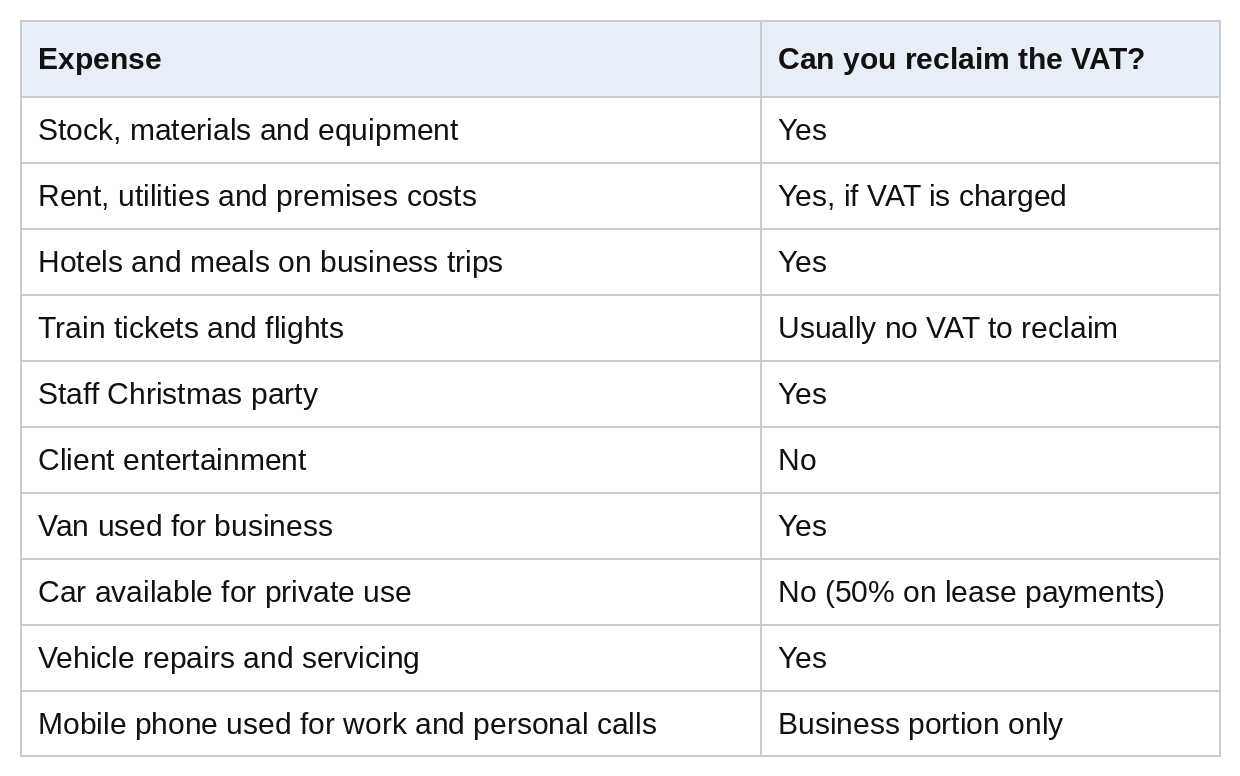
At A Glance
Expenses Used For Business & Personal Purposes
If you buy something that is used partly for your business and partly for personal use, you can only reclaim the VAT on the business portion. A good example is a home office. If one room in your home is used as your office, you might reclaim VAT on a share of your energy bills, but not all of them.
You’ll need to work out a fair and reasonable split, and keep a record of how you calculated it in case HMRC asks.
If You Make VAT-Exempt Sales
If your business makes both taxable and exempt sales, you are classed as partially exempt. This means you can’t usually reclaim all your VAT on expenses, and you’ll need to split it between the two. If the VAT linked to your exempt sales is small enough, the de minimis rules may still allow you to reclaim it all. This is an area where professional advice is well worth it.
Can You Reclaim VAT on Purchases Made Before Registering?
Yes, in many cases. When you first register for VAT, you can reclaim VAT on some purchases you made beforehand:
- Goods bought up to four years before your registration date, as long as you still have them or used them to make goods you still have
- Services bought up to six months before your registration date
The purchases must be for the business you’ve registered for VAT, and you’ll need the original VAT invoices. You claim this VAT on your first VAT return.
What Records Do You Need?
Good records are the foundation of claiming VAT on expenses. For each purchase, you’ll normally need a valid VAT invoice showing the supplier’s name, address and VAT number, a description of what you bought, the date and the VAT charged.
For purchases of £250 or less (including VAT), a simplified invoice is usually enough. A till receipt with no supplier VAT number, or a bank statement on its own, is not.
Under Making Tax Digital, you also need to keep digital records and file your VAT returns using compatible software. Keeping on top of this throughout the year is much easier than chasing missing invoices at the end of each quarter, which is where professional bookkeeping can save you both time and money.
How To Reclaim VAT on Expenses
You reclaim VAT on expenses through your VAT return, usually every quarter. Add up the VAT on all qualifying purchases for the period and enter it as input VAT. Your software will then work out whether you owe HMRC or are due a refund.
If you missed a claim, you can usually still make it on a later return. You have up to four years from the date you should have claimed.
If You Use The VAT Flat Rate Scheme
The rules are different if you’re on the VAT Flat Rate Scheme. You pay HMRC a fixed percentage of your turnover, and in return you can’t reclaim VAT on most purchases. The main exception is a single purchase of capital goods costing £2,000 or more (including VAT).
Why Get Help With Your VAT?
The rules on what you can claim VAT back on are full of exceptions, and small mistakes add up. Claim too little and you pay more VAT than you need to. Claim too much and you risk penalties if HMRC checks your returns.
At Prosper, our VAT return services make sure you reclaim every penny you’re entitled to, and nothing you’re not. We’ll review your expenses, check your invoices, deal with tricky areas like vehicles and mixed-use costs, and submit MTD-compliant returns on time. Combined with our bookkeeping services, your records stay accurate and up to date all year round.
Reclaiming VAT On Expenses FAQs
What can you claim VAT back on?
If you’re VAT registered, you can claim VAT back on most goods and services you buy for your business. This includes stock, equipment, premises costs, software, professional fees, business travel and staff entertainment. You can’t reclaim VAT on personal costs, client entertainment or cars available for private use.
Can I reclaim VAT if I’m not VAT registered?
No. Only VAT-registered businesses can reclaim VAT on expenses. If you register later, you may be able to reclaim VAT on goods bought in the previous four years and services bought in the previous six months.
Can I reclaim VAT without a VAT invoice?
Generally, no. You need a valid VAT invoice to support your claim. For purchases of £250 or less (including VAT), a simplified invoice is usually acceptable.
Can I reclaim VAT on client entertainment?
No. VAT on entertaining clients, suppliers or other non-employees is blocked. You can usually reclaim VAT on entertaining your own staff.
How far back can I reclaim VAT?
You can usually correct a missed claim on a later VAT return, up to four years after the date you should have claimed it.
Can I reclaim VAT on a company car?
Only if the car is used exclusively for business and isn’t available for private use, which is rare. You can still reclaim VAT on business running costs, such as repairs, and usually 50% of the VAT on lease payments.
Make Sure You’re Claiming Everything You Should
If you’re not sure you’re claiming VAT on expenses correctly, or want someone to take your VAT returns off your hands, get in touch with Prosper today. Our experienced accountants will review your records, spot any missed claims and keep your VAT accurate and stress-free.
If you're in need of accountant fill out our form below and one of our team will be in-touch.